Summertime! We hope you’ve been able to find a little time to relax, re-charge and have some fun adventures with family and friends this summer! As we all begin to think about summer winding down, we’re here to remind you that ERI has many CEU course opportunities available for you to improve your level of care while advancing your career.
Gain new skills to improve care for your patients or students.
At ERI, our CEU courses feature hands-on learning and evidence-based practice from inspiring, internationally renowned instructors. Our interactive, web-based courses include live Q&A sessions, hands-on applications, video analysis and problem-solving, allowing you to connect directly with experts in their field and fellow therapists, and earn continuing education credits – all from the convenience of home!
Browse the list below to see what we’ve got coming up in August…there’s really something for everyone: Physical Therapists, Occupational Therapists, Speech-Language Pathologists, Early Interventionists and Special Educators!
Click the links to learn more about each course and to register.
ERI is excited to announce the first annual Birth to Three Conference scheduled for April 4 and 5, 2024. Save the date and help us spread the word! This virtual conference will be geared towards OTs, PTs and SLPs working within the birth – three population.
This conference is applicable to a variety of pediatric settings, including early intervention, hospital inpatient and outpatient, outpatient private practice, rehab, home care, or specialty clinic. Therapists can expect to learn tools to strengthen the building blocks and lay a strong foundation to enhance the future growth and development of the child.
The course agenda is currently being finalized, and we will share more details as they become available. Interested in receiving updates on topics and presenters? CLICK HERE to be the first to know as we continue to update the conference…stay tuned!
We’ve developed a birth to three Facebook group as a way to connect pediatric therapists working within this population. Within this space, therapists are encouraged to ask questions, give suggestions, share ideas or recent research, and discuss challenges that relate to the birth to three child and family. This is a closed group for professionals only.
ERI faculty will also be contributing posts on hot topic issues, recent studies and giving feedback on challenging cases. This is a supportive group and we encourage you to post your questions or share your tips and ideas. Click here if you’d like to join in on the Facebook conversation!
ERI is committed to renewing your passion for school-based therapy and providing you with tools and strategies you can use right away to improve learning outcomes for your students.
Every year, ERI’s Therapies in the School Conference brings the very best speakers to share the very latest research and school-based therapy techniques—and their passion for their work—with hundreds of school-based therapy professionals just like you. This year is no different!
Two-Day Live Webinar Designed for School-Based Physical Therapists, Occupational Therapists, Speech Language Pathologists and Special Educators
We are excited to share the finalized speaker line-up for ERI’s Therapies in the School 24th Annual Conference 2023, set for November 16 and 17, 2023! Energetic experiential learning, lively panel discussions, and challenging breakout sessions will give you powerful new therapeutic tools and techniques. Browse the complete topic and speaker line-up HERE.
Offered for up to 12 Continuing Education Hours (1.2 CEUs). Group rates and one-day rates are available.
View, download and printour comprehensive brochure, highlighting the full outline, objectives, CEU details, faculty information and registration guidelines.
Extend Your Learning with ERI
ERI’s Therapies in the School Conference builds a therapy community across the country that stays in touch long after the conference closes. Our annual conference also starts a conversation that continues all year with school discussion groups, be sure to join if you haven’t already. Powerful professional development for school-based professionals is a key part of the ERI mission, and school discussion groups provide a forum for therapists and educators to ask questions and share insights online.
Register Now to SAVE!
SAVE $100off your 2-day registration fee forERI’s Therapies in the School 24th Annual Conference 2023when youregisterbefore August 19, 2023. Use coupon codeTherapies2023at checkout.
Reserve your spot now. We can’t wait to learn with you!
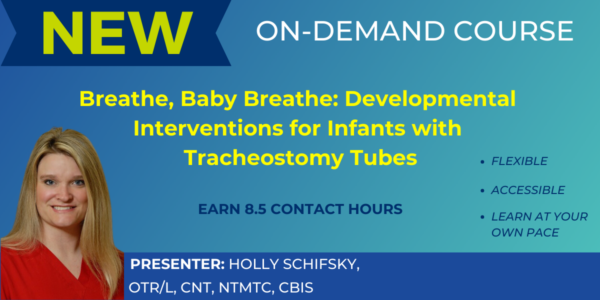
This hands-on intermediate-advanced course will focus on the cardiopulmonary implications for the premature or medically-complex infant as related to physiological stability, evolving motor control, sensory stability, and transition to oral motor skills that support feeding. It will focus on advancing the critical reasoning skills of the neonatal therapist to support the infant’s ability to obtain foundational motor and sensory skills.
This course is recommended for intermediate to advanced neonatal therapists, PTs, PTAs, OTs, OTAs, and SLPs working with infants in the Neonatal Intensive Care Unit. Participants of this course will earn 15 contact hours upon completion (1.5 CEUs).
Continue learning with Holly with these additional courses:
School may be out, but the learning continues! Check out all of the courses Holly Schifsky will be teaching this summer and fall. Registration is now open so be sure to get the dates on your calendar:
Person-first language refers to emphasizing a person instead of their disability when speaking to or about them. For example, instead of saying “a disabled person,” person-first language encourages us tosay “a person living with a disability.”
Whilethe distinction may seem minor, it helps us understand that someone’s disability is not their defining characteristic and does not impact their value. With person-first language, the speaker automatically categorizes the disability as a secondary attribute rather than referring to someone in terms of their condition or diagnosis.
What Is Identity-First Language?
Identity-first language refers to speaking about people with disabilities by putting their disability first, such as saying “she is disabled” or “he is autistic.” Identity-first language is the opposite of person-first language because it names the disability as an adjective, rather than emphasizing their personhood.
While person-first language seems morewidely adopted in recent yearsfor therapists and special educators to prevent stereotyping and stigmatizing disabilities, many self-advocates prefer identity-first language because they feel itbetter respects neurodiversity.
Person-First Language vs. Identity-First Language Examples
Person-first language examples include:
Person who is blind
Person who is visually impaired
Person with a disability
Wheelchair user
Person with cerebral palsy
Person who has muscular dystrophy
Person with epilepsy
Person on the autism spectrum
Person with an intellectual, cognitive or developmental disability
Person who has multiple sclerosis
Person with a mental health condition
Person who has a learning disability
Identity-first language examples:
Blind person
Handicapped
Wheelchair-bound
Epileptic
Autistic
Suffers hearing loss
A Deaf person
A disabled person
Afflicted by multiple sclerosis
A mentally ill person
Learning disabled
When You Should and Should Not Use Person-First or Identity–First Language
Whenchoosingwhetherto use person-first or identity–first language, remember torespectyour patients’ or students’ preference. As noted above, some peoplewould rather useidentity-first language for several reasons, like accepting their disability as part of their identity or reminding others that a disability is nota negative attribute. Asa therapist, there’s no need to pick a side with person-first or identity-first language.
While many professional health care organizations, such as theAmerican Medical Association, endorse person-first language, others prefer identity-first language. Some groups, such as theDeaf, blind and autistic communities, promote identity-first language. While these communities recognize the value of person-first language, they embrace their differences as an integral part of their identities.
For example, the Deaf community has made it known that they feel deafness isnot a disability but rather a medical conditionthat does not carry a negative connotation. For example, you would not usually separate the word “beautiful” from the phrase “beautiful person” and say something like “a person who is beautiful.” Some people feel person-first language makes their disability seem like a negativity that needs to be separate from their identity.
On the other hand, many people with disabilities may think identity-first language is limiting, insensitive or stigmatizing, which is why it’s crucial to ask about their preferences. Either type of language is equally appropriate depending on what your patient is comfortable with, so if you’re unsure how to address or refer to someone, ask.
Tips for Thoughtfully Using Person-First or Identity-First Language
It can be challenging to navigate these language standards when people have different preferences. Here are some tips to help you thoughtfully and respectfully speak to and about your patients with disabilities.
Educate yourself: The language we use when talking to and about people with disabilities is evolving. Preferences and terminologies have changed dramatically over the last decade and continue to do so. As a therapist, keep up with word choice to the best of your abilities. Ideally, you’ll want to stay informed on your patients’ specific disabilities and adjust as needed.
Be open-minded: While your intentions may be good, everyone makes mistakes. You may misspeak if you’re switching between person-first and identity-first language for various clients. Remember to have an open mind and be willing to listen. If you’re meeting a patient for the first time, try to gauge their views and adjust your terms as necessary.
Avoid using negative stereotypes: We want to be careful about saying anything that may unintentionally imply that a person’s disability is a negative thing. For instance, if you need to reference a person without a disability, never use terms like “normally abled” or “healthy” to describe them. These phrases make it sound as if the person with a disability is abnormal or less than.
Ask each client about their preferences: Remember, language is always changing. If you aren’t sure, ask how a person wants you to describe them. While this may initially seem a bit awkward, it can set a tone that lets patient know you care and value their needs.
Stay curious: Ongoing education is critical as a therapy professional. Regularly check sources like self-advocacy groups and community organizations to learn about the language they use and why.
Avoid portraying people with disabilities as inspirational: According to the CDC, we want to avoid describing a person with a disability as “an inspiration” or “courageous” because of their differences. This framing shines a negative light on their disability and makes it appear as a hindrance or struggle to overcome.
Improve Outcomes for Your Patients and Fuel Your Passion for Therapy With Education Resources, Inc.
As a practice or school-based therapist, you’re constantly working with new patients or students and seeing the world through their eyes. The language you use during your sessions and beyond can make a significant impact and help you provide a better experience and higher standard of care to everyone you interact with. At Education Resources, Inc., it’s our goal to help therapists and speech-language pathologists rediscover their passion for patient care and learn new strategies to help improve their patients’ daily lives.
We offer various continuing education units applicable to your practice. Whether you want to learn in a real classroom, with on-demand online courses or in a live webinar, we can meet your needs and provide high-quality content taught by passionate, engaging faculty members in your field.Contact us todayto learn more about creating an inclusive, respectful environment or check out ourearly intervention and school-based therapy courses.
Join Our Mailing List
Join our community to receive CEU course information to meet your professional development goals, hear the latest therapy tips, treatment ideas and connect with other therapists.